In this page
AI Email Sorting Assistant for Gmail
They sort and classify your incoming emails.

In this page
AI Sorting Assistant (Formerly AI Tagging)
The Gmelius AI Sorting Assistant helps you stay productive and streamline your workflows. It automatically analyzes incoming email conversations and applies the most relevant category based on their content.
These labels help you gain visibility into your inbox: identify patterns, spot bottlenecks, track trends, and automate actions, such as automatically archiving emails from specific categories to keep your inbox clean.
How to Enable Email Sorting Assistant
The Email Sorting Assistant is available for all personal inboxes of Gmelius subscriptions on the Meli, Growth, Pro, and Enterprise plans (see our Pricing page).
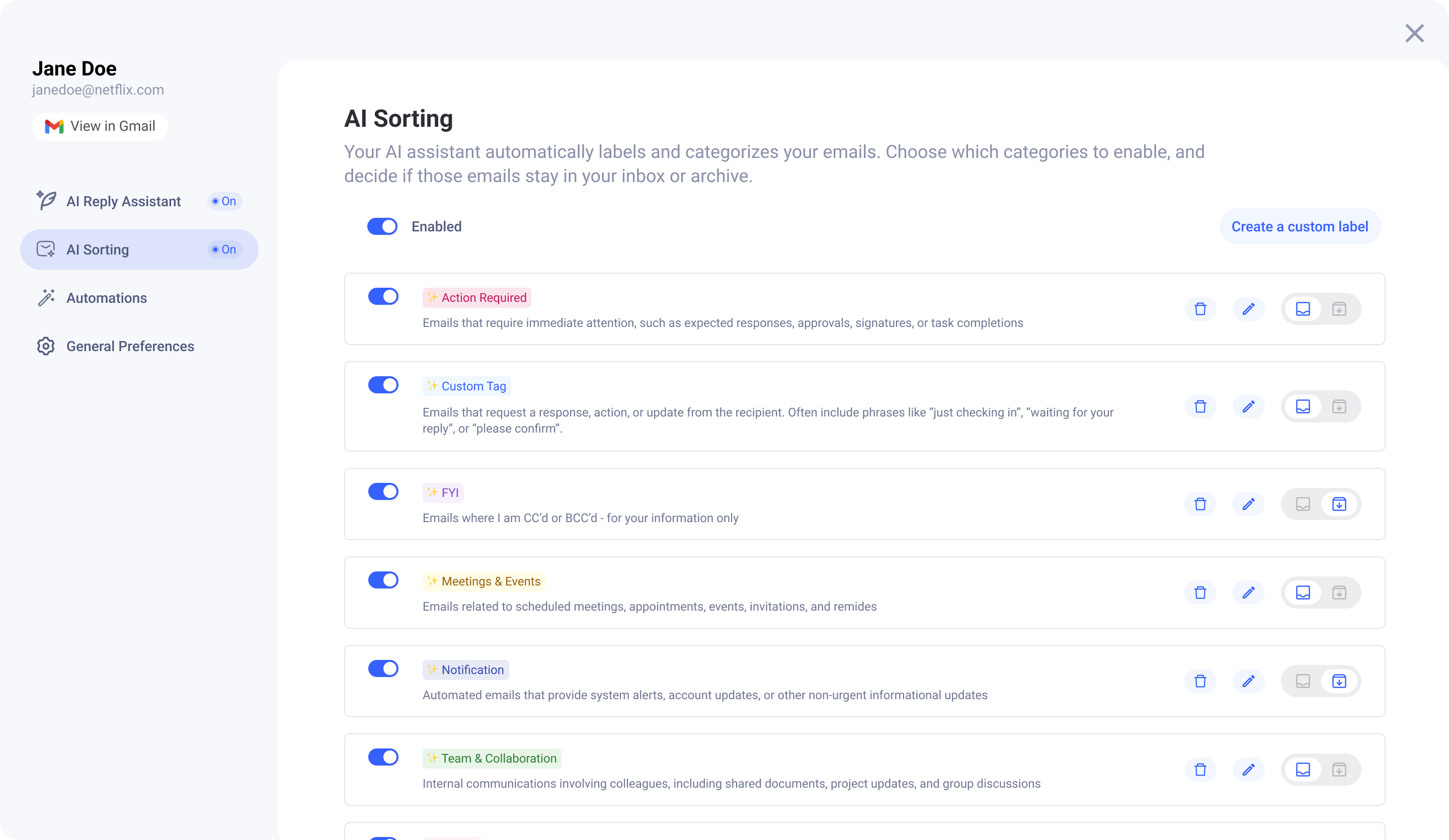
- Open Gmelius dashboard and go to your Workspace list.
- Select your personal inbox to configure it.
- Open the AI Sorting tab.
- Choose from a wide range of pre-defined tags, or create your own custom tags.
How AI Sorting works
Once enabled, the Email Sorting Assistant automatically analyzes new email conversations and applies the most relevant label based on their content.
When AI Sorting is enabled for the first time, Gmelius also categorizes up to 50 recent past conversations. This one-time preview helps you quickly understand how emails will be categorized going forward.
Email sorting runs automatically in the background and applies to Gmelius shared inboxes and personal inboxes.
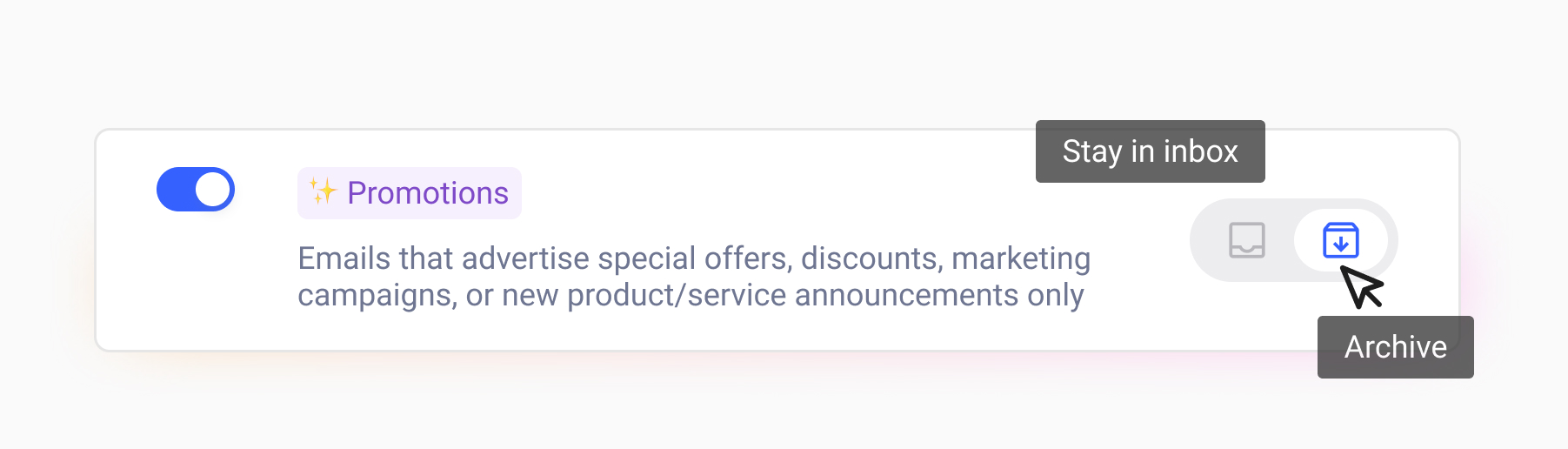
Archive control for each category
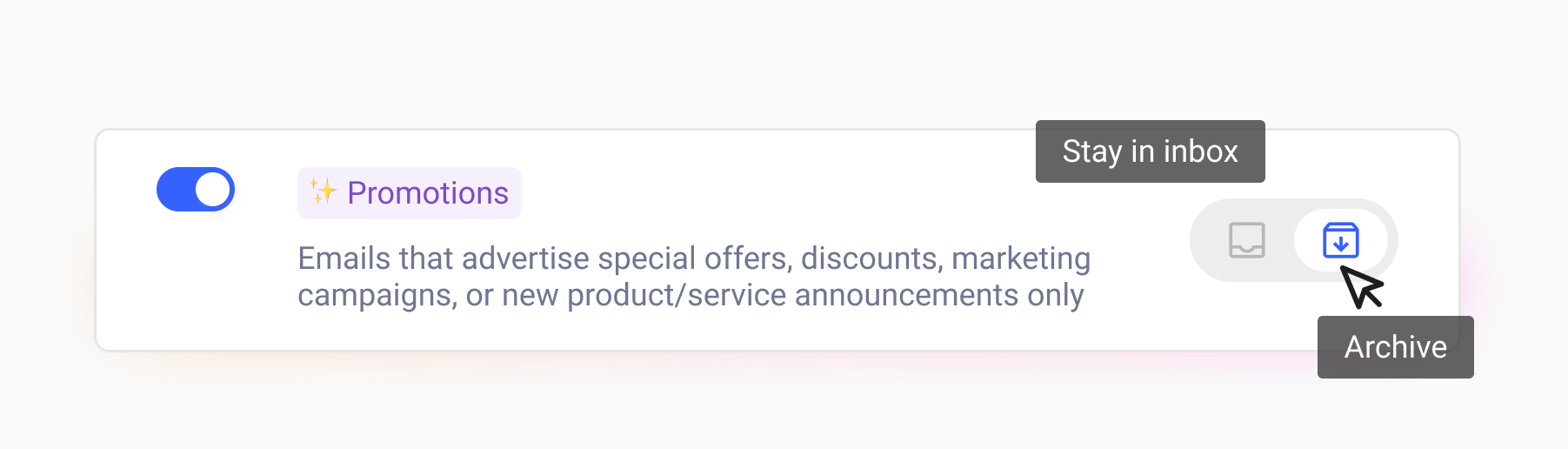
Next to each category in the AI Sorting setup, you'll see an additional control that lets you decide how tagged emails are handled:
- Stay in Inbox: Emails are tagged but remain in your inbox for regular processing.
- Archive Automatically: Emails are tagged and moved out of your inbox immediately.
Go Further
Analyze Your Inbox with Enhanced Analytics
Navigate to app.gmelius.com/analytics and explore the Tags tab. This section provides detailed insights into how frequently each tag is applied, your average response time, the average time to close an email with a specific tag, and much more. For comprehensive information, please refer to our guide: Guide: Analytics and Reporting.
Automate Workflows with Tag-Based Rules
Leverage the power of Email sorting by automating actions based on the applied tags. You can create trigger rules that are automatically executed when specific tags are applied to a conversation. To set this up, go to your dashboard and create a new rule, selecting the applied tag as the trigger and assigning the resulting action to the appropriate teammate.
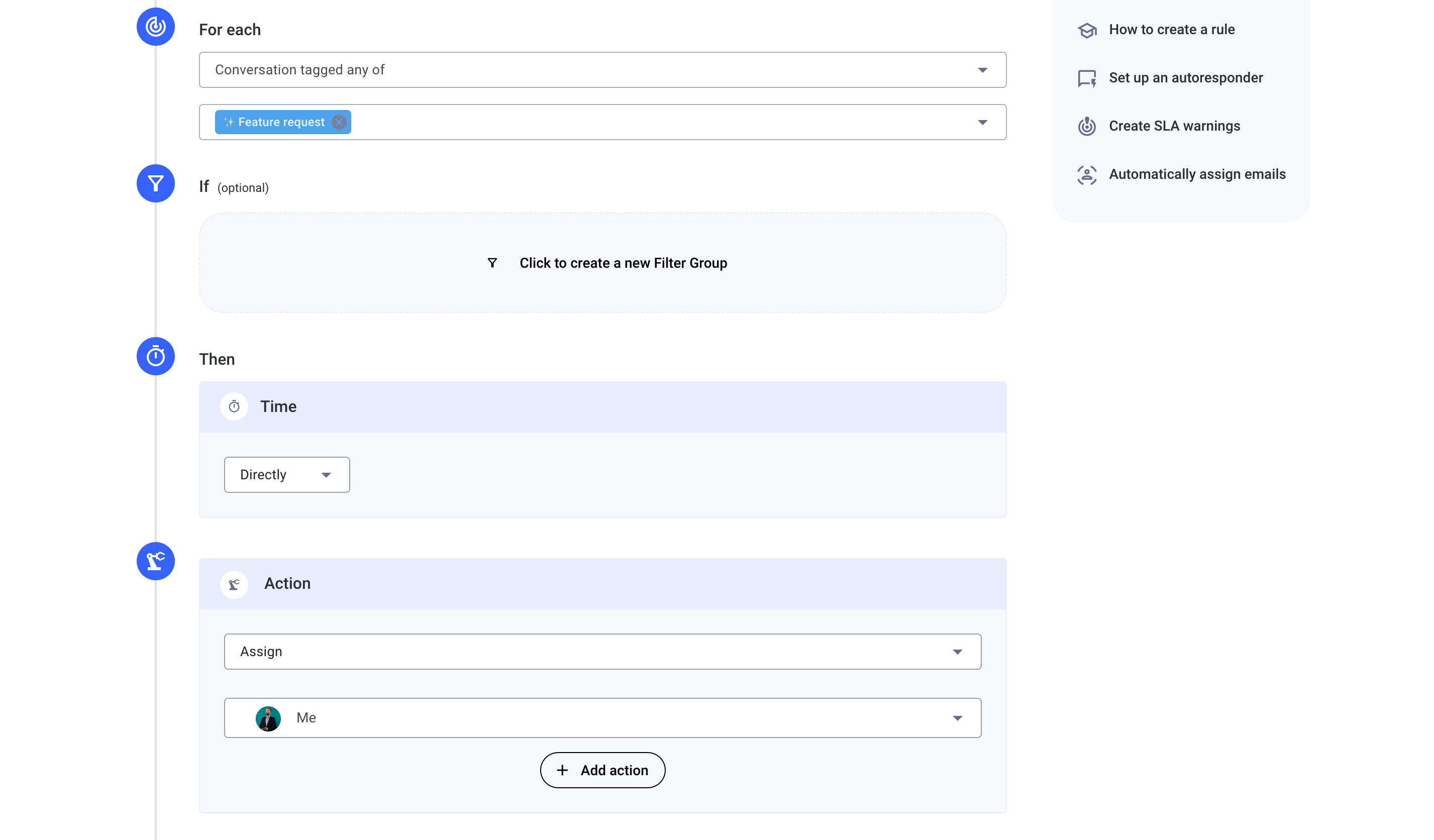
For detailed instructions on creating and using rules, please consult our article: Understanding Gmelius Rules. You can also learn more about advanced automation possibilities with tags by visiting the AI Architect and click on "Create rule with AI". This will help you create this rule by using natural language.
FAQ
Is my data used for training purposes?
No, we have never collected and will never collect any data from your emails for training purposes. We are firmly committed to protecting your data and respecting your privacy. To ensure this, we utilize Google's internal Gemini models, and your data is only processed in transit before being discarded. You can review our privacy notice here: Privacy Policy.
What is used to generate the tags from my emails?
Currently, our system analyzes the content of the first message in your email conversation to determine the relevant tags. We recognize that this might have limitations in terms of accuracy, and we plan to incorporate more context in the future to ensure all relevant details are considered.
Does your AI use attachments or notes?
No, the Email sorting feature only analyzes the text content of the first message in your conversations. Attachments and notes are not currently used for tag generation.
Does your AI work with multiple languages?
Yes, our system can understand and process multiple languages. While English offers the highest accuracy, other languages are also supported effectively. We encourage you to test this feature with your multilingual conversations and provide us with feedback on its performance in different languages.
To ensure consistent analytics, even if your email is written in a different language, the applied tags will be in English. Currently, it is not possible to customize the names of the tags applied by the AI.
What provider do you use for your AI?
We utilize Google's cutting-edge Gemini models, hosted on our partner Google Cloud Platform, for our Email sorting feature. Our initial release is based on these advanced models, ensuring robust and intelligent tag prediction. We adhere to a strict zero-retention policy for your data processed by these models.
What are the limitations of this feature?
During this initial phase, Email sorting will automatically tag only new conversations within your shared inboxes. If you manually add conversations to your shared inbox that are older than 4 days, they will not be automatically tagged. This feature is currently exclusive to shared inboxes and is not available for other workspaces like shared labels and boards.
Feedback
We are eager to hear about your experience with Email sorting! Please share your feedback with [email protected]. Your insights are invaluable in helping our product team improve and implement enhancements in future releases.
Book a call with a Product Coach
Need some help getting started with your AI assistant? Book a quick and free onboarding call with one of our Product Coaches below:
How did we do?
AI Dispatching
Using AI to categorize emails with Gmail labels
